
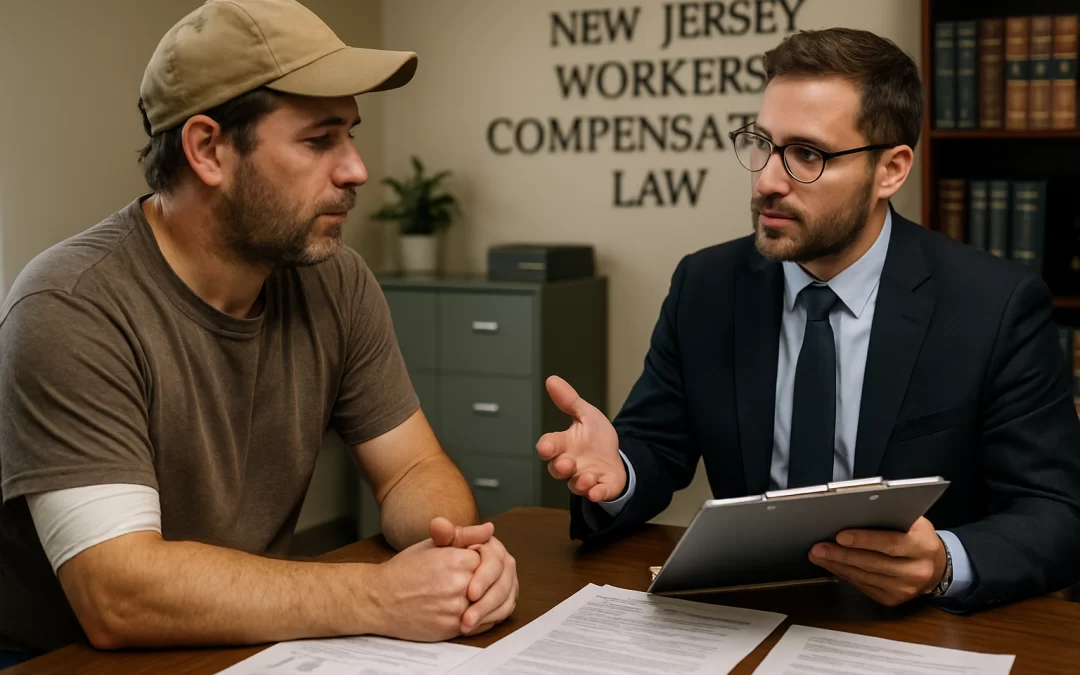
Workers’ compensation lawyers in New Jersey help injured workers file claims, deal with insurance companies, and fight for benefits when there are disputes, delays, or denials. They can guide you through medical treatment authorizations, temporary disability payments, and settlements, and represent you in workers’ compensation court if needed. Most straightforward claims take several months to resolve, while disputed or serious injury cases can take a year or more. Every case is different, and outcomes depend on your medical evidence, how the injury happened, and how the insurance company responds.
If you were hurt at work in New Jersey, you may be unsure whether to trust your employer, the insurance company, or your own instincts. This guide explains how New Jersey workers’ compensation works, when to involve a workers’ comp lawyer in NJ, and what to expect at each step. It is written for injured workers and families who are stressed, worried about income, and trying to make smart decisions without a legal background.
Table of Contents
- What New Jersey Workers’ Compensation Is and How It Works
- Common New Jersey Workplace Injury Scenarios
- What to Do First After a Workplace Injury in NJ
- Evidence and Documentation You May Need
- Deadlines and Time Limits for NJ Workers’ Comp Claims
- What a Workers’ Comp Lawyer in NJ Actually Does
- When You Should Hire a New Jersey Workers’ Comp Lawyer
- What Happens If You Do Nothing
- Possible Outcomes and How NJ Workers’ Comp Claims Are Resolved
- Costs, Legal Fees, and Potential Compensation
- Do You Need a Workers’ Comp Lawyer in NJ? Decision Guide
- Frequently Asked Questions
- Summary and Next Steps
What New Jersey Workers’ Compensation Is and How It Works
New Jersey workers’ compensation is a no-fault insurance system that provides medical care and wage replacement if you are injured or become ill because of your job. “No-fault” means you usually do not have to prove your employer did something wrong, only that the injury is work-related.
In most cases, you cannot sue your employer in civil court for a work injury; workers’ comp is normally your exclusive remedy against the employer. However, you may have additional rights against third parties (like a negligent driver or equipment manufacturer) in some situations, which a lawyer can evaluate.
Basic benefits available in New Jersey
While exact amounts depend on your wages and medical situation, New Jersey workers’ compensation may provide:
- Medical treatment for your work-related injury or illness, usually with doctors chosen by the employer or its insurance company.
- Temporary disability benefits (wage replacement) if you cannot work while recovering.
- Permanent partial disability benefits if you have a lasting impairment but can still work in some capacity.
- Permanent total disability benefits if you are unable to return to any gainful employment.
- Death benefits for dependents if a worker dies from a job-related injury or illness.
For more detail on how long benefits can last, you can review guidance such as how long workers’ comp typically lasts, keeping in mind that every case is unique and laws vary by state.
How the NJ workers’ comp process generally works
While each case is different, most New Jersey workers’ compensation claims follow a similar path:
- You are injured or become sick because of your job.
- You report the injury to your employer as soon as possible.
- Your employer notifies its workers’ compensation insurance carrier.
- The insurance company investigates and either accepts or disputes the claim.
- You receive medical treatment and, if needed, temporary disability benefits.
- If there is a dispute, you or your lawyer can file a claim petition or application for an informal hearing with the New Jersey Division of Workers’ Compensation.
- The case may settle or go to a hearing before a workers’ compensation judge.
Common New Jersey Workplace Injury Scenarios
Work injuries in New Jersey can happen in almost any job, not just construction or factory work. Understanding common scenarios can help you see whether your situation likely falls under workers’ comp.
Typical work accidents and injuries
- Slip, trip, and fall accidents on wet floors, cluttered walkways, or icy parking lots.
- Lifting and overexertion injuries, such as back, shoulder, or knee injuries from moving heavy items.
- Repetitive stress injuries like carpal tunnel syndrome from typing, scanning, or assembly line work.
- Machinery and equipment accidents causing crush injuries, amputations, or fractures.
- Vehicle accidents while driving for work, making deliveries, or traveling between job sites.
- Exposure to harmful substances leading to respiratory issues, skin conditions, or occupational diseases.
- Workplace violence or assaults in certain jobs, such as healthcare, retail, or security.
You can see more examples in resources that discuss common workplace injuries and how they’re handled, but always remember that facts and laws differ by state and by case.
Situations that often lead to disputes
Disagreements with the insurance company or employer are common in certain types of cases, including:
- Pre-existing conditions (for example, a prior back problem that is made worse by work).
- Gradual or repetitive injuries where there is no single accident date.
- Injuries that occur off-site (such as while traveling, working from home, or at a client location).
- Disputes over whether you were “on the job” at the time of the injury.
- Allegations of horseplay, intoxication, or policy violations around the time of the accident.
These are the types of cases where a workers’ comp lawyer in NJ can be especially important, because the legal and factual issues can be more complex.
What to Do First After a Workplace Injury in NJ
The steps you take in the first hours and days after a work injury can strongly affect your claim. Acting quickly and documenting what happened can protect both your health and your legal rights.
Step 1: Get medical help
- If it is an emergency, call 911 or go to the nearest emergency room.
- Tell every medical provider that your injury is work-related.
- Follow the doctor’s instructions and keep all follow-up appointments.
In non-emergency situations, your employer or its insurance company usually has the right to direct you to an authorized doctor. If you are unsure where to go, ask your employer or HR department in writing.
Step 2: Report the injury to your employer
- Notify your supervisor, manager, or HR as soon as possible, ideally in writing (email or text).
- Include the date, time, place, and how the injury happened.
- Keep a copy or screenshot of your report for your records.
Even if the injury seems minor at first, report it. Some injuries worsen over time, and late reporting can give the insurance company a reason to question your claim.
Step 3: Confirm that a workers’ comp claim has been opened
- Ask your employer who the workers’ compensation insurance carrier is.
- Confirm that the claim has been reported to the insurer.
- Watch for letters or phone calls from the insurance company about your claim number and benefits.
If you do not receive any information or benefits and your employer is not cooperating, this is a sign you may need legal help.
Step 4: Protect your rights from the beginning
- Write down what happened while it is still fresh in your mind.
- Get names and contact information for any witnesses.
- Take photos of the accident scene, equipment, or visible injuries if possible.
- Avoid posting about your injury or activities on social media.
Evidence and Documentation You May Need
Workers’ compensation is supposed to be simpler than a lawsuit, but evidence still matters. Good documentation can make the difference between a smooth claim and a difficult dispute.
Key documents to keep
- Accident report or written notice you gave to your employer.
- Medical records, including ER reports, doctor notes, test results, and prescriptions.
- Work restrictions or “out of work” notes from your doctor.
- Pay stubs or wage records from before and after the injury.
- Correspondence from the insurance company, including approvals, denials, and checks.
- Any surveillance or incident reports if your employer prepared them.
Evidence that can strengthen your claim
- Photos or videos of the accident scene, equipment, or hazard.
- Statements or contact information from co-workers who saw what happened.
- Notes about your pain levels, limitations, and how the injury affects daily life.
- Records of mileage or transportation costs for medical appointments (if reimbursable).
A workers’ comp lawyer in NJ can help you gather and organize this evidence, and can request additional records or expert opinions if needed.
Deadlines and Time Limits for NJ Workers’ Comp Claims
New Jersey has specific deadlines for reporting injuries and filing workers’ compensation claims. Missing a deadline can seriously limit or even destroy your right to benefits.
Reporting the injury to your employer
- New Jersey law generally requires you to give notice of a work injury to your employer within 90 days of the accident or when you realize the condition is work-related.
- Verbal notice may be enough, but written notice is safer because it creates a record.
Filing a formal claim petition
- In New Jersey, you usually have two years from the date of the accident or the last payment of compensation (such as medical treatment or temporary disability benefits) to file a formal claim petition with the Division of Workers’ Compensation.
- For occupational diseases or conditions that develop over time, the two-year period often runs from when you first knew, or should have known, that the condition was related to your job.
These are general rules, and there can be exceptions or special situations. Because deadlines are so important, it is wise to speak with a New Jersey workers’ comp lawyer promptly if you are unsure about timing.
What a Workers’ Comp Lawyer in NJ Actually Does
Many injured workers are not sure what a workers’ compensation lawyer actually does or whether it is worth getting one involved. In New Jersey, a workers’ comp lawyer’s role is to protect your rights, handle the legal process, and push back when the insurance company underpays or denies benefits.
Handling the legal and procedural side
- Explaining your rights and options under New Jersey workers’ compensation law in plain language.
- Filing claim petitions, motions, and other documents with the Division of Workers’ Compensation.
- Tracking deadlines and court dates so nothing is missed.
- Preparing you for hearings, depositions, and medical examinations.
Dealing with the insurance company
- Communicating with the adjuster so you do not have to handle every call or letter.
- Challenging delays, denials, or attempts to cut off your benefits.
- Negotiating settlements and advising you on whether an offer is fair.
- Requesting additional medical treatment or second opinions when appropriate.
Building and presenting your case
- Gathering medical records and, when needed, arranging independent medical evaluations.
- Obtaining wage records and calculating the correct benefit rate.
- Presenting evidence and arguments to a workers’ compensation judge at hearings.
- Identifying possible third-party claims outside of workers’ comp, such as against a negligent driver or equipment manufacturer, and referring you to appropriate counsel if needed.
When You Should Hire a New Jersey Workers’ Comp Lawyer
Not every minor work injury requires a lawyer, but many situations do. The more serious or complicated your case, the more likely it is that a workers’ comp lawyer in NJ can make a real difference.
Signs you should strongly consider hiring a lawyer
- Your claim has been denied or your benefits were suddenly stopped.
- The insurance company says your injury is not work-related or is due to a pre-existing condition.
- You have serious injuries, surgery, or permanent limitations.
- You are being pressured to return to work before you feel ready, or your employer will not honor your doctor’s restrictions.
- You are offered a settlement and are not sure if it is fair.
- You suspect your employer is retaliating against you for filing a claim, such as cutting hours, demoting you, or threatening your job.
If your claim has already been denied, you may find it helpful to read more about what happens when a workers’ comp claim is denied and then speak with a lawyer about your specific options.
Situations where you might handle it yourself
Some workers choose to handle simple claims on their own, especially when:
- The injury is minor, clearly work-related, and you fully recover quickly.
- The insurance company promptly approves treatment and pays correct temporary disability benefits.
- There are no disputes about how the injury happened or your ability to return to work.
Even in these cases, a brief consultation with a New Jersey workers’ comp lawyer can help you understand your rights and avoid mistakes, often at no upfront cost.
What Happens If You Do Nothing
Some injured workers hope the problem will go away on its own or are afraid to “rock the boat” with their employer. Doing nothing, however, can have serious consequences.
Risks of not reporting or pursuing your claim
- You may lose your right to benefits if you miss reporting or filing deadlines.
- You could end up paying for medical treatment out of pocket or through your own health insurance.
- You might return to work too soon, risking further injury or long-term damage.
- Without a formal claim, there may be no record of your injury if problems worsen later.
Impact on your job and income
Workers often worry about being fired or punished for filing a claim. While New Jersey law generally prohibits retaliation for exercising your workers’ compensation rights, problems can still arise in practice. Resources that address questions like whether you can be fired while on workers’ compensation can provide additional context, but a lawyer can give advice tailored to your situation.
Possible Outcomes and How NJ Workers’ Comp Claims Are Resolved
New Jersey workers’ compensation cases can end in several ways, depending on your medical recovery, work status, and whether there are disputes.
Common types of resolutions
- Ongoing benefits: You continue to receive medical treatment and temporary disability benefits until you reach maximum medical improvement.
- Settlement for permanent partial disability: You receive a lump sum or structured payments based on the degree of permanent impairment.
- Permanent total disability benefits: If you cannot return to any gainful work, you may receive ongoing benefits, subject to periodic review.
- Denial or dismissal: If the judge finds the injury is not compensable or deadlines were missed, the claim may be denied.
How long a New Jersey workers’ comp case can take
Timelines vary widely:
- Simple, accepted claims with full recovery may resolve in a few months.
- Cases involving surgery, long-term treatment, or disputes can take a year or more.
- Formal claim petitions in workers’ compensation court often involve multiple hearings and negotiations over many months.
The length of your case depends on your medical progress, how quickly the insurance company responds, and whether there are legal disputes that must be decided by a judge.
Costs, Legal Fees, and Potential Compensation
Many injured workers hesitate to contact a lawyer because they are worried about cost. In New Jersey workers’ compensation cases, legal fees are usually structured to make it easier for injured workers to get help.
How workers’ comp lawyer fees typically work in NJ
- Most New Jersey workers’ comp lawyers work on a contingency fee basis, meaning they are paid a percentage of the recovery approved by the court, not upfront by you.
- Attorney fees in workers’ compensation cases are generally subject to court approval and capped by law.
- In many cases, a portion of the fee is paid by the insurance company and a portion from your award, but the exact structure depends on the outcome and the judge’s order.
You should always ask any lawyer you speak with to explain their fee structure clearly before you sign anything.
What affects the value of a workers’ comp case
While no lawyer can guarantee a specific settlement or result, some common factors that influence the value of a New Jersey workers’ comp case include:
- The severity and type of injury (for example, a sprain versus a spinal injury or amputation).
- Whether you need surgery or long-term medical care.
- Your average weekly wage before the injury.
- Whether you can return to your old job, a different job, or cannot work at all.
- The degree of permanent impairment assigned by medical experts.
When hiring a lawyer may increase your financial outcome
- If the insurance company is undervaluing your permanent disability or pushing a low settlement.
- If there are disputes about medical treatment or the need for surgery.
- If your benefits have been cut off prematurely or you are being pushed back to work too soon.
- If you may have a third-party claim in addition to workers’ comp.
On the other hand, if your injury is minor, quickly resolved, and fully covered without dispute, the financial benefit of hiring a lawyer may be smaller, though you can still seek a consultation for peace of mind.
Financial risks of not taking action
- Losing wage replacement benefits you might have been entitled to.
- Missing out on compensation for permanent impairment.
- Paying for medical care that should have been covered by workers’ comp.
- Accepting a settlement that is too low for your long-term needs.
Do You Need a Workers’ Comp Lawyer in NJ? Decision Guide
Deciding whether to hire a workers’ comp lawyer in NJ depends on your injury, your finances, and how your employer and the insurance company are treating you. Use the questions below as a practical guide.
Questions to ask yourself
- Is my injury serious (surgery, fractures, long-term pain, or permanent limits)?
- Has the insurance company denied or delayed my claim or medical treatment?
- Am I missing paychecks or receiving less than I think I should?
- Do I feel pressured to return to work before I am ready?
- Am I being treated differently at work since my injury?
- Have I been offered a settlement that I do not fully understand?
If you answer “yes” to one or more of these questions, it is usually wise to at least speak with a New Jersey workers’ comp lawyer about your options. If you answer “no” to all of them and your claim is running smoothly, you may be able to continue handling it yourself while staying alert for any changes.
When to act immediately versus wait
- Act immediately if your claim is denied, your benefits stop, or you are told to return to work against medical advice.
- Act soon if you have serious injuries, surgery scheduled, or permanent limitations.
- You may wait and monitor if your injury is minor, you are healing well, and benefits are being paid correctly—but keep an eye on deadlines and any signs of dispute.
For a deeper dive into this decision, you may find it helpful to review resources focused on whether you need a lawyer for a workers’ comp case, while remembering that New Jersey law has its own specific rules and procedures.
Frequently Asked Questions
How long do I have to report a work injury in New Jersey?
In New Jersey, you generally must report a work-related injury to your employer within 90 days of the accident or when you realize the condition is related to your job. Reporting as soon as possible is best, and written notice provides stronger proof if there is a dispute later.
Can I choose my own doctor for a workers’ comp claim in NJ?
In most New Jersey workers’ compensation cases, the employer or its insurance company has the right to choose the treating doctor. There are exceptions in emergencies or certain disputed situations, so if you are unhappy with your care, speak with a workers’ comp lawyer about your options.
What if my New Jersey workers’ comp claim is denied?
If your claim is denied, you can challenge the decision by filing a claim petition or requesting an informal hearing with the New Jersey Division of Workers’ Compensation. Because denials can be complex, many workers choose to work with a lawyer at this stage to build evidence and present their case.
Will I lose my job if I file a workers’ comp claim in NJ?
New Jersey law generally prohibits employers from retaliating against you for filing a workers’ compensation claim. However, disputes about job status, layoffs, or performance can still arise, so it is important to document everything and seek legal advice if you suspect retaliation.
Can I work light duty while on workers’ comp in New Jersey?
If your doctor clears you for light-duty work and your employer offers a suitable position within your restrictions, you may be expected to return. If no appropriate light-duty job is available, you may continue receiving temporary disability benefits, but the details depend on your medical status and the employer’s offerings.
How long can I receive workers’ comp benefits in NJ?
The length of time you can receive benefits depends on the type of benefit and your medical condition. Temporary disability benefits last while you are unable to work and under active treatment, while permanent disability benefits follow specific schedules and rules; a lawyer can explain how these may apply in your case.
Summary and Next Steps
Being injured at work in New Jersey can leave you worried about your health, your job, and your finances. The workers’ compensation system is designed to provide medical care and wage replacement, but insurance companies do not always make the process easy, especially in serious or disputed cases.
A workers’ comp lawyer in NJ can help you understand your rights, handle the legal process, and push for the benefits you may be entitled to under state law. If your claim is denied, delayed, or you are dealing with serious injuries or pressure from your employer, it is usually wise to get legal guidance sooner rather than later.
If you are unsure what to do next, consider speaking with a qualified New Jersey workers’ compensation attorney for a case review. A short conversation can clarify your options, help you avoid costly mistakes, and give you a clearer plan for protecting your health, income, and future.